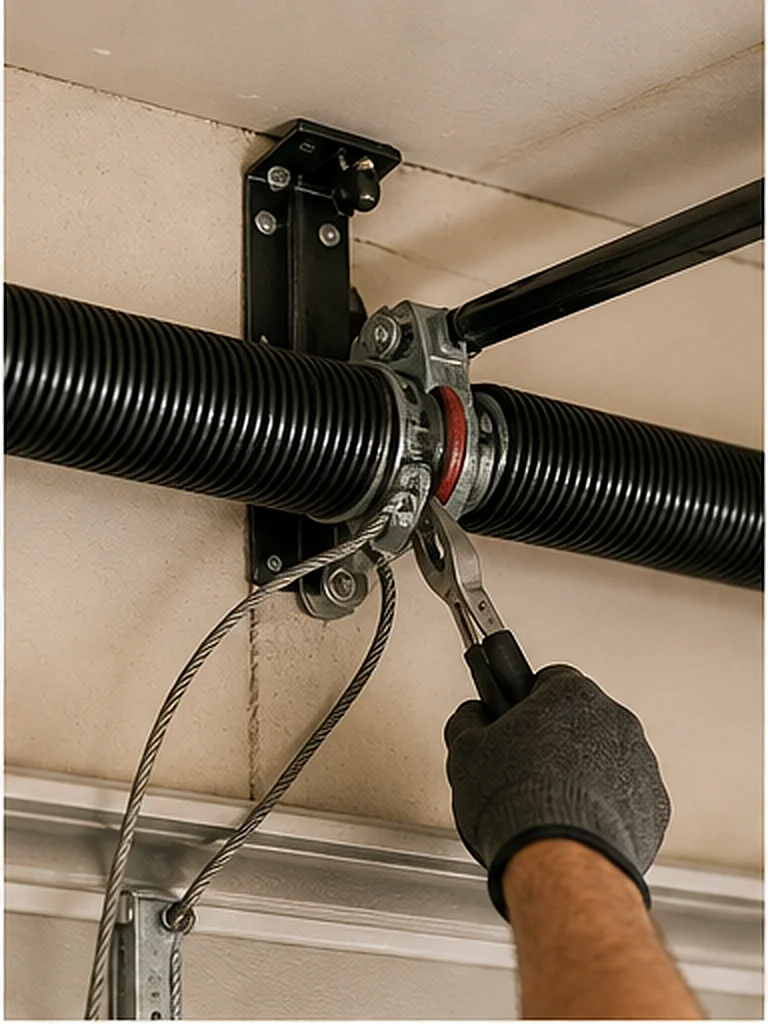
Why a broken spring stops the entire system
Garage door springs counterbalance most of the door weight. The opener guides the movement; it is not designed to lift the full weight of the door by itself. When a spring breaks, continuing to press the wall button can damage the opener gear, rail, carriage, or top section.
Torsion and extension spring systems
Many modern doors use a torsion spring mounted on a shaft above the door. Some lighter or older systems use extension springs along the horizontal tracks. The correct repair depends on door weight, spring dimensions, cycle rating, drum and cable condition, and whether the system uses one or two springs.
Why spring replacement requires specialized tools
Springs are wound under controlled tension. Improvised tools can slip and release that energy without warning. A proper spring repair includes securing the door, matching the replacement spring, setting the correct turns, checking cables and drums, lubricating the coils, and testing the balance by hand before reconnecting the opener.
Signs the other spring may also be worn
On a two-spring system, both springs have usually completed a similar number of cycles. If one breaks, the second may be near the end of its service life. The best recommendation depends on age, condition, rust, prior replacements, and measured door balance—not a one-size-fits-all rule.
Frequently asked questions
Broken Spring Repair FAQ
Can an opener lift a door with a broken spring?
It may move the door slightly, but using it can overload the opener and is not recommended.
How do I know if the spring is broken?
Look for a gap in a torsion spring, a hanging extension spring, a loud bang, or a door that suddenly became very heavy.
Can a broken spring be repaired instead of replaced?
A broken spring is replaced. It cannot be safely welded or reconnected for continued use.
Request service
Describe the problem and send a photo.
Use the quote form to share the ZIP code, symptoms, and an optional photo of the damaged area.