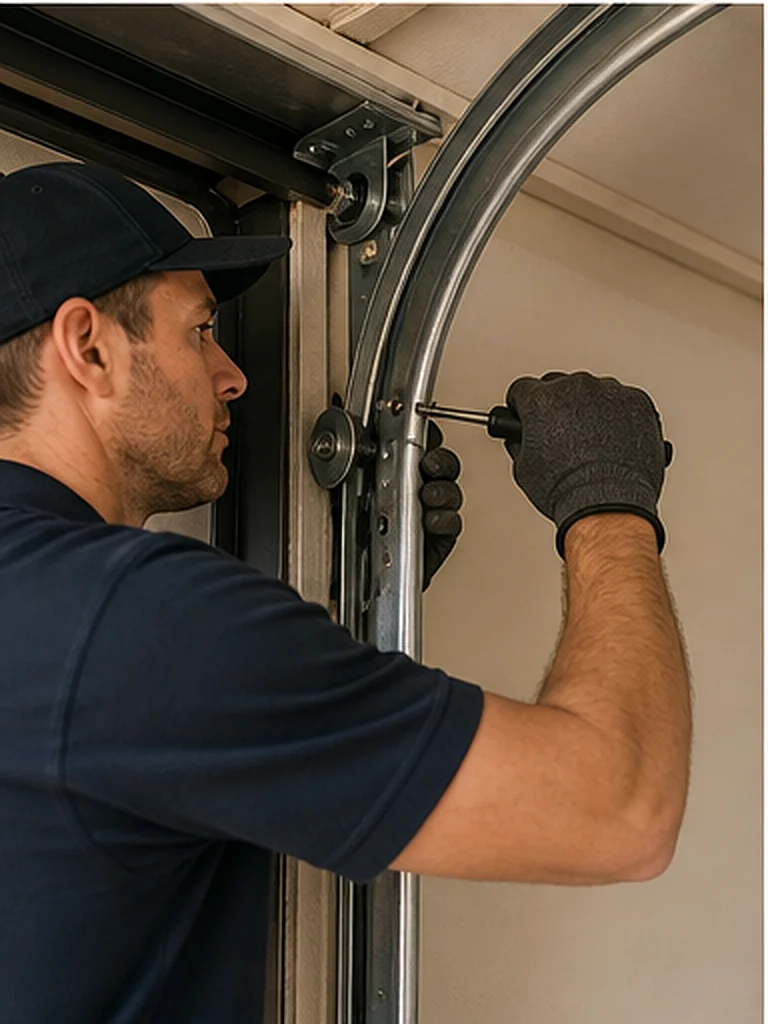
Track damage is often part of a larger problem
A track can bend from impact, loose fasteners, an escaped roller, a cable failure, or forcing a crooked door. The repair should identify why the track moved rather than only hammering the visible bend.
Vertical, curved, and horizontal track alignment
The vertical tracks guide the door up the opening, the radius transitions the sections overhead, and the horizontal tracks support the open door. Spacing and elevation must match the door, roller stems, and flag-bracket geometry.
Repair versus track replacement
Minor localized deformation may be corrected when the metal remains strong and the roller path can be restored. Severely creased, cracked, rusted, or repeatedly damaged track should be replaced with a compatible section.
What to inspect after track work
Rollers, hinges, cables, drums, bottom fixtures, jamb brackets, flag brackets, rear hangs, and opener limits should be checked. A track repair is not complete until the door moves smoothly by hand and remains stable through its full travel.
Frequently asked questions
Track Repair FAQ
Can a bent garage door track be repaired?
Some minor bends can be corrected, while severe creases, cracks, or distorted sections usually require replacement.
Why does the track keep moving?
Loose mounting points, impact, structural movement, poor rear supports, or a binding door can shift the track repeatedly.
Can I operate the door with a bent track?
It is better to stop. Continued use can damage rollers, cables, panels, and opener parts or cause the door to leave the track.
Request service
Describe the problem and send a photo.
Use the quote form to share the ZIP code, symptoms, and an optional photo of the damaged area.